Divergent Paths in the South Caucasus
By Laura Linderman
When President Donald Trump welcomed Armenian Prime Minister Nikol Pashinyan and Azerbaijani President Ilham Aliyev to the White House in August 2025, the ceremony celebrated more than just the hope that decades of conflict between the two neighboring states might finally be coming to an end. The agreement initialed that day, which grants the United States long‑term development rights to a transit corridor ambitiously named the Trump Route for International Peace and Prosperity (TRIPP), marked a watershed moment in the geopolitics of the South Caucasus. For the first time in modern history, a major peace process in the region had bypassed Moscow entirely in favor of Western mediation.
Yet the TRIPP agreement’s deeper significance lies not in American diplomatic triumph, but in what it reveals about a regional transformation—and the limits of that transformation. Russia’s war in Ukraine has created a window of opportunity for the South Caucasus, a moment when Moscow’s strategic distraction has given regional states unprecedented room to maneuver. The question is not whether this window exists, it clearly does, but how long it will remain open, and which states have the capacity to exploit it before it closes.
The answers vary dramatically. The South Caucasus has moved from what Zbigniew Brzezinski famously called the “grand chessboard,” where great powers moved regional states as pawns, to what Svante E. Cornell and Damjan Krnjević Mišković describe in the introduction to their edited volume, titled After Karabakh: War, Peace, and the forging of a New Caucasus (2025), as a “card table,” where each state holds its own sovereign hand of playing cards.
But not all hands are equal. Azerbaijan sits at the card table with a strong hand, leveraging energy resources, geographic indispensability, and military victory to extract value from multiple powers simultaneously. Armenia plays a weak hand the best it can under the circumstances, having initiated much of the TRIPP process to escape isolation and avoid being further diminished by Azerbaijan; a survival strategy, but a strategy nonetheless. And one could say that it looks as if Georgia has lit its best cards on fire or eaten them, with its government seemingly choosing preservation over strategic opportunity.
The scene at the metaphorical card table after the most recent hand has been dealt is not, as some Western commentators have assumed, a straightforward regional pivot away from Russia toward the West. Nor is it the emergence of a coherent new form of sovereignty. It is something messier: three states responding to the same geopolitical shock with radically different resources, constraints, and choices. The West has increasingly set aside the post‑Cold War vision of liberal internationalism, with its emphasis on open markets, multilateral institutions, and shared sovereignty, in favor of a more transactional approach to statecraft. States the world over, including Armenia, Azerbaijan, and Georgia, are adapting to this reality, but adaptation looks very different depending on whether you’re negotiating from strength or desperation.
The End of the Near Abroad
Russia’s war in Ukraine has accelerated a transformation that was already underway. As Thomas de Waal of Carnegie Europe has argued, “Putin’s war on Ukraine marks the end of the near abroad —the idea that Russia enjoys a special status with its post‑Soviet neighbors.” The mechanisms through which Moscow maintained regional dominance for three decades; frozen conflicts, military bases, the Collective Security Treaty Organization (CSTO), the Eurasian Economic Union (EAEU), energy dependence, and information warfare, have all eroded, some dramatically. De Waal identifies several components of this transformation: ‘sovereignty reasserted’ describes how national elites beyond Russia’s borders are reclaiming independence, while ‘situational strategy’ characterizes Russia’s shift from integration projects to ad hoc policymaking. Moscow, he notes, now has “fewer instruments of soft power and capacity to fight an information war as Russian‑language media is less influential.”
The collapse of Russian security guarantees proved most consequential. When Azerbaijan went into and held Armenian sovereign territory in 2022, Armenia invoked Article 4 of the CSTO collective defense treaty. Russia explicitly rejected intervention, with officials declaring that the organization’s mutual defense provisions did not apply, arguing in part that the border with Azerbaijan had not been delineated. This was not an isolated incident but part of a pattern: Russia had not intervened militarily on the side of Armenia in the Second Karabakh War, arguing (correctly) that Armenian sovereign territory was not under attack, and influenced by (at the time) warming ties with Baku, displeasure with Armenia’s pro‑Western government led by Prime Minister Nikol Pashinyan, and reliance on Türkiye as an economic sanctions lifeline. Moscow subsequently stood aside during Baku’s September 2023 “anti‑terror operation” that ended the conflict over Karabakh entirely. Months later. Russia withdrew its peacekeeping force, a striking reversal for a power that has typically treated military deployments in the former Soviet space as permanent facts on the ground.
The data on Armenian public opinion tells a stark story of this betrayal’s impact. According to International Republican Institute polling, positive views of Russia among Armenians dropped from 93 percent in 2019 to 31 percent in 2024. The Middle East Institute has documented a comprehensive “de‑Russification” of Armenian defense procurement, with Russia’s share of Armenian arms purchases falling from 96 percent in 2021 to less than 10 percent in 2024. Trust in the Russian‑led Eurasian Economic Union has collapsed to just 38 percent, while confidence in the European Union has risen to 62 percent. Even more tellingly, 75 percent of Armenians now believe the European Union should play a greater role in strengthening Armenia’s defense.
Yet it would be a mistake to interpret these shifts as a permanent transformation. The region’s states have learned a hard lesson: that distant security guarantees from any external power is no substitute for the careful balancing that preserves genuine autonomy. De Waal himself warns that Russia may return to more assertive South Caucasus engagement once the Ukraine conflict stabilizes. The period in which the three South Caucasus states have been able to conduct foreign policy more independently of Moscow could prove temporary rather than permanent. The Chatham House analyst Laurence Broers has introduced the concept of “managed decline” to describe the withdrawal of Russian peacekeepers from Karabakh, a deliberate repositioning rather than involuntary retreat. If Broers is right, what looks like Russian weakness may be Russian choice; and choices can be reversed.
Yet a weakened Russia may also be a more dangerous one. As my AFPC and CACI colleague Mamuka Tsereteli has argued, the war in Ukraine has produced a paradox for American strategy: it has significantly reduced Russia’s long‑term strategic power while hardening Moscow into a more risk‑tolerant adversary. Russia’s losses are structural, encompassing demographics, energy leverage, and regional influence, but the challenge for Western policymakers is to lock in these setbacks while managing escalation risks in Moscow’s neighborhood. Armenia’s June 2026 parliamentary elections represent a particular pressure point, where Russia retains significant leverage through its military bases in the country, control of strategic infrastructure, and soft‑power tools.
This uncertainty shapes everything that follows. Regional states are not building a new permanent order; they are maneuvering within a window whose duration is unknown. The critical question is which states have the capacity to lock in gains before that window closes.
Azerbaijan: Exploiting the Window from Strength
Azerbaijan exemplifies what strategic maneuvering looks like when executed from a position of strength. Having won the territorial conflict over Karabakh on its own terms, with crucial Turkish support but without direct Russian military intervention on the side of its adversary, Baku no longer needs to worry about Moscow using the territorial dispute as leverage. President Ilham Aliyev can now engage Washington, Moscow, Ankara, Tehran, and Beijing simultaneously, extracting value from each relationship without becoming any power’s client. Cornell notes: “Azerbaijan has embarked on a foreign policy that seeks to maintain functioning relations with all neighbors and avoid making itself dependent on any particular power for its security.”
The structural foundations of Azerbaijan’s confident posture are substantial. The country supplies approximately 5 percent of the EU’s oil and 6 percent of its gas, giving it leverage that limits EU pressure on governance issues. The Southern Gas Corridor, linking Azerbaijan’s Shah Deniz field with European markets, has elevated Baku’s importance to the European Union at precisely the moment when it began desperately seeking alternatives to Russian energy. The 2021 Shusha Declaration formalized Azerbaijan’s strategic alliance with Türkiye, providing security guarantees that substitute for the need for any Russian or Western commitment. This partnership has grown significantly in the energy and defense sectors, with Turkish Bayraktar drones playing a decisive role in Azerbaijan’s military victory in the 2020 Second Karabakh War.
Most recently, U.S. Vice President JD Vance’s February 2026 visit to Baku resulted in a Charter on Strategic Partnership between Azerbaijan and the United States, formalizing cooperation across energy, connectivity, artificial intelligence, and security. The document represents the highest level of bilateral cooperation in the history of the bilateral relationship, signaling Washington’s recognition of Azerbaijan as a strategic hub rather than merely an energy supplier, a shift that reflects the Trump Administration’s transactional approach to regional engagement.
Azerbaijan’s geographic position amplifies these advantages. As Krnjević has argued, Azerbaijan functions as a “keystone state;” one with “sufficient force and authority to stand on its own,” serving as an “interlocutor, […] intermediary, and critical mediator” between major powers. The country straddles both ends of TRIPP and sits where the Middle Corridor “seamlessly blends” into China’s Belt and Road Initiative. It is also where the east‑west route optimally intersects with the International North‑South Transport Corridor linking Russia, Iran, and India. This geographic indispensability means that every major power must engage Baku on its terms, though this leverage may yet be more conditional than it appears. Azerbaijan has passed peak oil production, faces fiscal pressures, and boasts a military that is formidable only by regional standards. Should the Middle Corridor remain more marketing exercise than genuine trade bonanza, and should de‑globalization continue to accelerate, Baku’s bargaining position could prove more fragile than current confidence suggests.
Baku has translated these structural advantages into what scholars Farid Shukurlu and Joseph Shumunov call “Active Non‑Alignment;” a foreign policy that actively leverages competition among external powers rather than passively avoiding alignment. Unlike Cold War‑era non‑alignment, which emphasized avoidance, Azerbaijan’s posture is proactive, pragmatic, and sovereignty‑centered. The country maintains normal ties with Russia while deepening its alliance with Türkiye, sells energy to a growing number of EU member states and candidate countries while becoming a key player in east‑west trade routes, and has emerged as a tacit pillar in the growing alliance between moderate Arab states and Israel. Baku has even announced it will export 1.2 billion cubic meters of natural gas annually to Syria through Türkiye, symbolizing a significant shift in regional energy cooperation.
The transformation in Azerbaijan’s foreign policy posture is captured in presidential adviser Hikmat Hajiyev’s formulation: “Azerbaijan won the war, and now Azerbaijan is winning the peace.” The main difference between Azerbaijan’s old and new foreign policy, analysts note, is that Baku now negotiates as a powerful, sovereign regional leader, placing its national interests at the center of its diplomacy. It is now certain, and undeniable, that Azerbaijan is no longer merely a follower of the regional order but an active player shaping regional norms, order, and events as a rising keystone state.
Yet success carries its own risks. The very confidence that has enabled Azerbaijan’s strategic breakthroughs may, if unchecked, move into overreach. The recent tensions with Moscow‑sparked by the December 2024 passenger jet incident and subsequent mutual recriminations illustrate how quickly relationships can deteriorate when a state tests the boundaries of even a weakened partner. Azerbaijan’s careful balancing has succeeded precisely because Baku has avoided becoming the “next Georgia or Ukraine,” states that provoked Russian military responses by moving too quickly toward Western alignment.
But the friction has not come to an end; it has perhaps even deepened. At the February 2026 Munich Security Conference, Aliyev publicly accused Russia of deliberately striking Azerbaijan’s Kyiv embassy three times in 2025, noting that even after Baku provided Moscow with the coordinates of its diplomatic missions, two additional attacks followed. That Aliyev chose to make these accusations on the same platform where he held yet another meeting with Ukrainian President Volodymyr Zelenskyy suggests Baku is increasingly willing to signal displeasure with Moscow in full public view.
The challenge now is maintaining discipline in how Azerbaijan approaches Russia amid a string of its victories. Analysts have noted that Baku’s sustained policy orientation, whether one attributes this to strategic acumen or the absence of competing visions, has enabled the kind of patient relationship‑building that regional transformation requires. But this structural coherence demands strategic patience: the temptation to press advantages while Russia remains distracted must be weighed against the reality that Moscow retains significant capacity for disruption, and that the regional balance enabling Azerbaijan’s rise could shift when the Ukraine conflict concludes. The skills that won the peace, including pragmatism, restraint, and the careful cultivation of relationships across rival blocs, remain essential to preserving it.
Armenia: Making the Most of a Difficult Hand
Armenia presents a fundamentally different case: not strategic maneuvering from strength but adaptation under duress. Yerevan initiated much of the TRIPP process precisely to avoid being further diminished by Azerbaijan and to escape the isolation that followed Russia’s abandonment. The Pashinyan government has learned from what it perceives as a major betrayal that formal alliance commitments can prove worthless when a patron’s priorities shift. Armenia is not simply reacting to circumstances; it is actively shaping them within severe constraints: Yerevan is following something like the Azerbaijani playbook, but without the leverage, alliances, or military capacity that make Baku’s approach comparatively straightforward.
Russia’s decision not to intervene on Armenia’s behalf in 2022, when Armenian sovereign territory was being threatened, reflected a strategic recalculation of Moscow’s interests. Specifically, this arose from Russia’s prioritization of military resources for its conflict in Ukraine over its defense obligations in the South Caucasus. For decades, Russia benefited significantly from its role as Armenia’s primary security guarantor, using the conflict over Karabakh to maintain regional leverage and preserve its military presence. When that calculus changed, Armenia became expendable.
The constraints Yerevan now faces are severe. Armenia remains approximately 70 percent economically dependent on Russia. It is landlocked, with Türkiye’s border closed and Azerbaijan controlling access to the east. Trade with Russia actually surged from $2.6 billion in 2021 to $7.3 billion in 2023, at least $12 billion in 2024, and more than $6 billion in 2025 (Armenia’s total foreign trade dropped 29 percent in 2025, relativizing possible overinterpretation in its decline in trade with Russia from its peak in 2024). This is a pattern visible across the South Caucasus, as all three states have experienced increased commercial flows with Russia since Western sanctions took effect. The region’s geographic position makes it a natural transit corridor, and distinguishing legitimate trade from sanctions circumvention has proven difficult for governments navigating between Western pressure and economic reality. For Armenia, this commercial entanglement complicates Yerevan’s declared pivot toward diversification. All Russian military bases, including the largest at Gyumri, remain operational. These structural dependencies limit Yerevan’s freedom of maneuver in ways that Baku does not face.
If Azerbaijan is playing poker with a strong hand, then Armenia is playing the same game with far fewer chips, but is playing it, nonetheless. Yet Armenia has achieved tangible results from Western engagement, not because it has leverage, but because Western powers see value in preventing complete Russian reconsolidation of the region. Defense cooperation with France has produced regular shipments of Bastion armored vehicles. Weapons partnerships with India have made New Delhi Armenia’s largest defense supplier. Joint military exercises with the Kansas National Guard under the Eagle Partner program have continued annually since 2023. U.S. Secretary of State Antony Blinken’s diplomatic interventions in late 2022 during Azerbaijani attacks on Armenian territory illustrated a Western willingness to actively support the country’s sovereignty in ways that Russia had refused to do. And, most significantly, the TRIPP agreement offers Armenia what a Trump Administration official described as the route’s strategic benefit: enabling a second transit route (the first runs through Georgia) between Türkiye, Azerbaijan, and Central Asia without passing through Iran or Russia.
Armenia’s political challenges are equally daunting. Pashinyan’s pivot has mobilized a diverse opposition coalition that includes clergy of the Armenian Apostolic Church, disillusioned oligarchs, the exiled leadership of the secessionist Armenian entity in Karabakh, and ordinary citizens unwilling to accept that former enemies can become partners in peace. This coalition has coalesced around a central argument: that Armenia’s security and regional interests can be guaranteed only through the full restoration of its security partnership with Russia. Yet this appeal to Russian protection faces fundamental obstacles that Pashinyan’s opponents largely ignore. These obstacles reflect both Russia’s changing strategic priorities and Armenia’s diminished value as a strategic asset. Armenia’s military weakness and diplomatic isolation have reduced its bargaining power with Moscow to near zero.
Each concession required to execute the strategic reorientation, especially those surrounding normalization with Azerbaijan and Türkiye, provides ammunition for opposition mobilization and risks electoral backlash (the country is scheduled to conduct a parliamentary election in June 2026). By agreeing to the dissolution of the OSCE Minsk Group, which was co‑chaired by Russia (as well as France and the United States) without securing a signed peace agreement in return, Pashinyan has essentially placed a high stakes bet that informal Western partnerships and verbal assurances will prove more reliable than formal institutional frameworks. The forthcoming election will provide the definitive test of whether Pashinyan’s government can break what might be called the “feedback loop,” in which the concessions required for strategic survival generate domestic opposition that threatens the very partnerships Armenia needs.
For Armenia, the appeal of Western engagement lies not in a sophisticated multi‑vector strategy but in the absence of alternatives. As Pashinyan declared in December 2025: “The normalization of Armenia‑Türkiye relations, peace between Armenia and Azerbaijan, the ‘TRIPP Route’ project, Armenia’s and Azerbaijani good‑neighborly relations with Georgia and Iran, [and] constructive dialogue with Russia, can position the South Caucasus as one of the most attractive transit corridors, alongside both the North–South and East–West routes.”
This framing (integration with everyone, subordination to no one) captures an aspiration more than a reality. Whether Armenia can translate this aspiration into genuine autonomy, or whether it will simply exchange one form of dependence for another, remains to be seen.
Georgia: When Domestic Politics Overwhelms Strategy
Georgia reveals what happens when domestic political considerations overwhelm strategic opportunity. The governing Georgian Dream party has moved toward accommodation with Moscow, not primarily from strategic calculation but because it prioritizes power retention over Euro‑Atlantic integration. The fear of becoming “the next Ukraine” provides convenient justification for choices driven by what the government’s opponents characterize as narrower interests. Georgia’s strategic culture, as scholar Michael Cecire has argued, is “preoccupied with its relative weakness regionally, and in the international system more broadly, and seeks out friends and balancers to maximize its autonomy.” Yet the Georgian government appears to have abandoned this logic. Where Azerbaijan leverages the current window to extract value from multiple powers, some Western observers argue that Georgia has chosen not to play at all; a decision that may prove catastrophic if the window closes with Tbilisi having locked in nothing.
This represents a puzzle that has confounded some Western analysts. One calls Georgia “a striking geopolitical outlier,” while Armenia and Azerbaijan distance themselves from Moscow, Georgia moves closer. Like its neighbors, Georgia has also seen trade with Russia increase since 2022, benefiting economically from its position astride transit routes even as its political trajectory diverges from the regional pattern. The explanation lies in the intersection of elite interests and threat perception. Some Western analysts argue that for Georgian Dream, even the prospect of taking the country’s first concrete steps toward achieving EU membership created a dangerous dilemma: maintaining power required moving in the opposite direction, passing legislation like the April 2025 Foreign Agents Registration Act that made a break with Brussels inevitable.
The argument is this: domestic survival imperatives directly contradicted the reform trajectory that official EU candidate status demanded. Bidzina Ivanishvili, the billionaire founder of Georgian Dream who reputedly remains the party’s de facto decisionmaker despite holding no formal office, appears to have made a decisive calculation that a shift in alignment toward Russia offers the most viable path forward. Unlike Western governments, which Ivanishvili apparently believes will never actually intervene to protect Georgia (the August 2008 precedent is an obvious reference point), Russia has occasionally sent troops to rescue allied regimes, as in Kazakhstan in 2022. Yet Moscow’s track record in the South Caucasus offers less comfort: Russian protection neither saved Armenia’s Moscow‑aligned president Serzh Sargsyan from being ousted in 2018, nor prevented Armenia’s military defeats in the Pashinyan era. The Georgian situation can thus be said not to be an example of multi‑vector hedging, but rather represents a decisive break: Ivanishvili and the party he founded have chosen not to believe Brussels’ promises. On the other hand, they don’t seem to believe Moscow’s either, which explains in part Tbilisi’s unwillingness to re‑establish diplomatic relations with a country that occupies two parts of its sovereign territory. Still, one can argue that extensive Russian business interests further reinforce the rapprochement calculus, creating personal incentives for accommodation that appear to diverge from the country’s constitutionally enshrined Euro‑Atlantic aspirations. Georgia risks long‑term strategic vulnerability—a bargain that Azerbaijan, with its genuine multi‑vector approach, has consistently refused to make.
The result is a striking paradox: large majorities of Georgians consistently favor walking along the path toward EU membership, yet their government moves in the opposite direction. In late 2024, Georgian Dream announced it would suspend EU accession negotiations until 2028, triggering sustained protests across the country. The EU responded by withholding €121 million and freezing the start of accession talks, with the Biden Administration choosing to withhold an additional $95 million in assistance. The country now faces a deepening divide between the implications of the government’s policy choices and public sentiment. Meanwhile, Georgian Dream has cultivated closer ties with non‑Western powers: trade with Iran has tripled since the party came to power in October 2012, and Chinese surveillance technology supplied by Huawei and Hikvision has been deployed in ways that raise concerns about its use against protesters.
Yet Georgia’s significance lies less in its governing party’s choices than in what those choices reveal about the limits of structural opportunity. The Middle Corridor presently runs through Georgian infrastructure: the Baku‑Tbilisi‑Ceyhan pipeline and the Baku‑Tbilisi‑Kars railway make Georgia essential to east‑west connectivity. This geographic reality has meant that external powers must engage Georgia on terms that preserve transit infrastructure, regardless of its domestic politics. While Tbilisi has avoided provoking Moscow, its relations with the West have deteriorated sharply, marked by hostile rhetoric toward Western diplomats and a rejection of EU conditions.
Georgia appears to be betting that geographic reality will force continued Western economic engagement regardless of political friction, though this assumption grows more precarious as the relationship sours. Yet this leverage depends on Armenia and Azerbaijan remaining at odds. Should normalization between Yerevan, Baku, and Ankara succeed in opening direct transit routes, then it might result in a new main Middle Corridor route, bypassing Georgia in favor of TRIPP, which would be both shorter and more direct (although the Georgian route provides access to Black Sea ports—a strategic advantage). Tbilisi’s current indispensability thus needs to be understood as conditional, not permanent. This could make Georgia’s failure to exploit its strategic position, while it still holds it, all the more consequential.
Georgia thus offers a cautionary lesson: windows of opportunity require not just favorable external conditions but domestic leadership willing to exploit them. Structure creates possibilities; leadership decides whether to use them. Georgia’s trajectory poses a question for the entire region: if domestic politics can overwhelm strategic logic so completely in one case, how durable are the gains being made elsewhere?
TRIPP: A Bet, Not a Breakthrough
TRIPP exemplifies both the possibilities and the uncertainties of the current moment. The agreement grants the United States exclusive development rights to a corridor connecting Azerbaijan to its Nakhchivan exclave via Armenian territory, with a U.S.‑structured consortium of commercial firms operating the necessary rail and road links, commodity transport infrastructure, and communications networks. Armenia will retain sovereignty, the corridor will operate under Armenian law, while the United States takes responsibility for ensuring it “operates safely for all parties.” Critical to the route’s long‑term viability will be its function as a genuinely neutral commercial passage; one that companies from any country, Western or non‑Western (including Iran and Russia), can use without political restriction. For this to work, no stakeholder, Western or non‑Western, may object to any company from any country using it.
What makes TRIPP particularly revealing is its symbolic character. As one presidential adviser involved in the negotiations explained, TRIPP functions as an “evil eye talisman;” a deterrent whose power lies in the signal it sends rather than in any concrete enforcement capacity. The United States is not providing a hard security guarantee or deploying forces to the route. There will be no American bases or garrisons in Armenia, much less in Azerbaijan. Instead, the American role is, as another official put it, “holding up the parasol and the umbrella, as needed, but we won’t be trying to change the weather.” Washington appears willing to live with this arrangement partly because the American contribution is fundamentally commercial; there are no U.S. defense commitments, no U.S. troops, and no U.S. security guarantees in the traditional sense.
The effectiveness of such a “talisman,” however, depends entirely on perception; should a regional power decide to test America’s commitment, the absence of traditional defense guarantees could expose the arrangement’s limitations. The gamble is that commercial interests can provide sufficient deterrence in a geography that has historically respected hard power above all else.
This framing captures something essential about the current moment—both its possibilities and its fragility. Regional states are not seeking American hegemony to replace Russian hegemony. They are seeking symbolic deterrents and commercial partnerships that increase their leverage without creating new dependencies. A critical uncertainty remains, however: will TRIPP demonstrate enough credible U.S. commitment to reassure European, Turkish, and South Caucasus partners to advance the corridor, particularly after Trump leaves office, while simultaneously avoiding actions that would trigger severe pushback from Russia, Iran, and China? The very structure of the agreement, commercial rather than military, symbolic rather than enforced, reflects regional preferences for transactional relationships over binding alliances.
TRIPP should be understood as a bet rather than a breakthrough. It is an experiment in whether commercial engagement can substitute for hard security guarantees—an experiment whose results will only become clear over years of implementation. The infrastructure does not yet exist. The Trump Administration’s follow‑through is uncertain, although Vance’s February 2026 visit to both Armenia and Azerbaijan seems to have quelled some previously expressed anxieties. The agreement has also not been tested by any serious challenge from Russia or Iran. For now, TRIPP represents a wager on the new regional logic rather than proof of it.
That being said, the country that has the most to gain from TRIPP has doubled down on its promise. Pashinyan has publicly characterized TRIPP as a strategic opportunity for economic cooperation that could benefit relations among regional powers, including those with strained bilateral ties. Iran’s balanced response to TRIPP shows that caution and pragmatism, rather than ideology, increasingly guide its South Caucasus policy. One could say something similar regarding the Russian reaction. Whether this optimistic framing proves accurate remains to be seen. But the fact that TRIPP has proceeded without triggering the kind of confrontation that characterized earlier Western initiatives in the post‑Soviet space suggests that the current window may offer genuine opportunities for those positioned to exploit them.
A Crowded Card Table
The Krnjević‑Cornell card table metaphor captures another essential feature of the new South Caucasus: the proliferation of external players. Russia and the Euro‑Atlantic community increasingly find their influence diluted not only by regional powers like Türkiye and Iran, whose involvement long predates the current moment, but by newer entrants including China, Israel, some GCC states, and India, which have expanded the competition beyond its traditional contours. This multipolarity explicitly rejects the Cold War‑era binary of Russian sphere vs. Western integration that structured earlier analysis.
Türkiye’s role is particularly significant. As noted above, the 2021 Shusha Declaration elevated Ankara’s relationship with Baku to a formal strategic alliance, and Turkish military support proved decisive in Azerbaijan’s 2020 victory. Yet Türkiye’s influence is constrained rather than hegemonic. Baku has resisted encirclement by any single ally, maintaining pragmatic and relatively stable relations with Moscow even as it moves closer to Ankara. Azerbaijan has even played a mediating role between Israel and Türkiye, helping to establish a red line mechanism in Syria that prevented escalation between forces backed by the two neighboring powers. This demonstrates that regional states can leverage external partnerships without becoming captives of them, at least when they have sufficient leverage to begin with.
Iran presents a more complex case. Tehran has repeatedly expressed opposition to the opening of corridors that might benefit its regional rivals, and spokesmen for the Revolutionary Guard Corps had, in years past, threatened military intervention if regional borders were redrawn. Yet having been subjected to a military campaign that demonstrated Israeli supremacy and strong American backing, Iran responded with relative silence to TRIPP’s inauguration. This reflected Tehran’s diminishing capacity and willingness to counter shifting power dynamics. For Armenia, Iran’s engagement, or at least its interest, in regional projects backed by the United States creates a favorable environment where sovereignty, security, and economic stability can be safeguarded. Iran remains neither a guarantor nor a bystander, but a decisive variable in the shifting balance.
China, meanwhile, steadily expands its economic and political presence. Chinese goods already transit westward via Azerbaijan, Georgia, and Türkiye at rapidly increasing rates, making Baku an important hub for the Belt and Road Initiative. The Middle Corridor’s strategic importance has risen for both Washington and Beijing, creating opportunities for regional exporters while intensifying competition. Notably, four of five states along the Middle Corridor—i.e., Azerbaijan, Kazakhstan, Türkiye, and Uzbekistan—are members of the Organization of Turkic States, with Tbilisi maintaining strong strategic ties with both Ankara and Baku. This emerging architecture offers regional states multiple pathways for engagement, reinforcing the ability of well‑positioned states to play external powers against one another.
The Window May Not Stay Open
The transformation described in this article is real yet provisional. Some analysts in Washington have begun quietly voicing concerns about what Russia’s overextension might mean beyond Ukraine. According to a former U.S. official who used to be involved in regional policy, Washington is monitoring the North Caucasus, where Moscow’s control over Dagestan, Chechnya, and other Russian republics could weaken as the Kremlin remains stretched thin by the war in Ukraine. Such concerns carry particular weight for Azerbaijan, which has strong interests in stability along its northern border. Indeed, Baku may be among the world’s most invested stakeholders in Russia avoiding internal fragmentation; a paradox that shapes how regional states approach their own relationships with Moscow.
For American policymakers, instinct favors managed stability: the same Russian weakness that enabled the TRIPP breakthrough could, if it deepens, generate unpredictable regional turbulence. Yet this framing may overstate the risks. Russia has historically been the primary driver of regional developments, and its further retrenchment could just as plausibly strengthen the case for alternative corridors while motivating regional powers to invest in their security.
Yet preferences do not determine outcomes. Russia’s structural vulnerabilities, including adverse demographics, the strains of prolonged war, and persistent risks of separatism in the North Caucasus, Volga region, and parts of Siberia, are not contingent on what Washington or Baku would prefer. The irony is that the very Russian weakness that has enabled the current window of opportunity could, if it deepens beyond a certain threshold, generate the kind of regional turbulence that neither American nor Azerbaijani policymakers want to manage.
Moreover, the staying power of Trump’s “business diplomacy” approach remains unproven. A key uncertainty remains whether U.S. engagement will prove sufficiently sustained to ensure not only a peace deal but its effective implementation. Because Trump prefers to use informal channels and rely on a small network of close, trusted friends and advisors, his ability to dock the results of his personalized diplomacy to domestic and interstate institutions that can handle day‑to‑day challenges is quite limited.
The question of reversibility haunts the entire transformation. De Waal’s “End of the Near Abroad” framework captures a genuine inflection point while remaining cautious about permanence. Russia may return to more assertive engagement once its Ukraine commitments ease. Many Western scholars have suggested that Moscow’s influence has genuinely diminished but may be reversible, particularly if the conflict in Ukraine concludes favorably for Russia. All three South Caucasus states are hedging against exactly this possibility, which is why even Azerbaijan, the most successful exploiter of the current window, has maintained pragmatic ties with Moscow rather than burning bridges. That said, Aliyev’s public accusation at the 2026 Munich Security Conference that Russia deliberately targeted Azerbaijan’s embassy in Kyiv, combined with his continued engagement with Zelenskyy, suggests that the pragmatic relationship is under real strain, and that Baku is willing to let Moscow know it (and not just behind closed doors, either).
The differential capacity of the three South Caucasus states to lock in gains before the window closes may prove decisive. Azerbaijan, with its energy leverage, Turkish alliance, and resolved territorial conflict, is best positioned to make the current moment permanent. Armenia, still desperately dependent on Russia and lacking structural leverage, may find its recent gains erode if Moscow reasserts itself. And Georgia, having chosen not to exploit its strategic position, may discover that the window has closed with Tbilisi having secured nothing.
The Opportunity for American Policy
The Trump Administration’s opportunity in the South Caucasus lies not in replacing Russian hegemony with American primacy, but in recognizing that sustainable engagement requires respecting these states’ circumstances and their limits. This sidesteps the democracy‑promotion and NATO‑expansion frameworks that shaped earlier U.S. engagement in the post‑Soviet space—approaches that generated expectations Washington was rarely prepared to fulfill.
The concept of “keystone states” that Krnjević and others have developed, including the U.S. Naval War College’s Nikolas Gvosdev, offers a useful framework for understanding what effective engagement might look like. Azerbaijan, like Kazakhstan and Uzbekistan in Central Asia, possesses sufficient weight and autonomy to engage major powers on its own terms rather than as a dependent client. Treating such states as partners rather than clients, accepting their simultaneous relationships with competitors, working through commercial rather than military mechanisms, and providing symbolic backing rather than binding commitments may prove more effective than the integration‑or‑confrontation framework that characterized some earlier post‑Cold War policies pursued by previous U.S. administrations and its European allies.
But American policymakers should be clear‑eyed about the variation within the region. What works for Azerbaijan, a state with genuine leverage, may not work for Armenia, which requires more substantive support to avoid sliding back into Russian dependence. And Georgia may end up no longer being a viable partner at all, regardless of the opportunities on offer.
The South Caucasus has not pioneered a new form of sovereignty so much as it has demonstrated what happens when a hegemon gets distracted: small states get room to maneuver, and the outcomes depend on their resources, constraints, and their leaders’ choices. The region has returned to its historical pattern as a geopolitical crossroads where multiple powers compete, but none dominates. This part of the world, Krnjević argues, “stands a chance of no longer remaining merely an object of major power competition—a geography to be won and lost by others; it is, rather, on the cusp of becoming a distinct, autonomous, and emancipated subject of international order.”
That chance is real; but it is a chance, not a guarantee. For the United States, this reality demands both engagement and humility. The three South Caucasus states are navigating a window of opportunity holding very different hands of playing cards. American policy that recognizes this variation‑offering partnership calibrated to each state’s actual capacity and circumstances has the best chance of producing durable results. The card table has room for everyone willing to play, but the hands that have been dealt are far from equal. American policy should be crafted accordingly. And it should always remember that a new round of play will inevitably follow once the current one plays itself out.
About the Author:
Laura Linderman is a Senior Fellow and Director of Programs at the Central Asia‑Caucasus Institute (CACI) of the American Foreign Policy Council (AFPC). She previously served as a Senior Fellow at the Atlantic Council’s Eurasia Center and has taught South Caucasian studies to U.S. diplomats at the Foreign Service Institute. The views expressed in this essay are her own.
Read the article here: https://bakudialogues.idd.az/articles/divergent-paths-in-the-south-caucasus-strategy-survival-retreat-04-03-2026
After Karabakh: War, Peace, and the Forging of a New Caucasus

by Svante E. Cornell and Damjan Krnjević Mišković
AFPC Press/Armin Lear, 2025
Link to Amazon and Kindle Edition
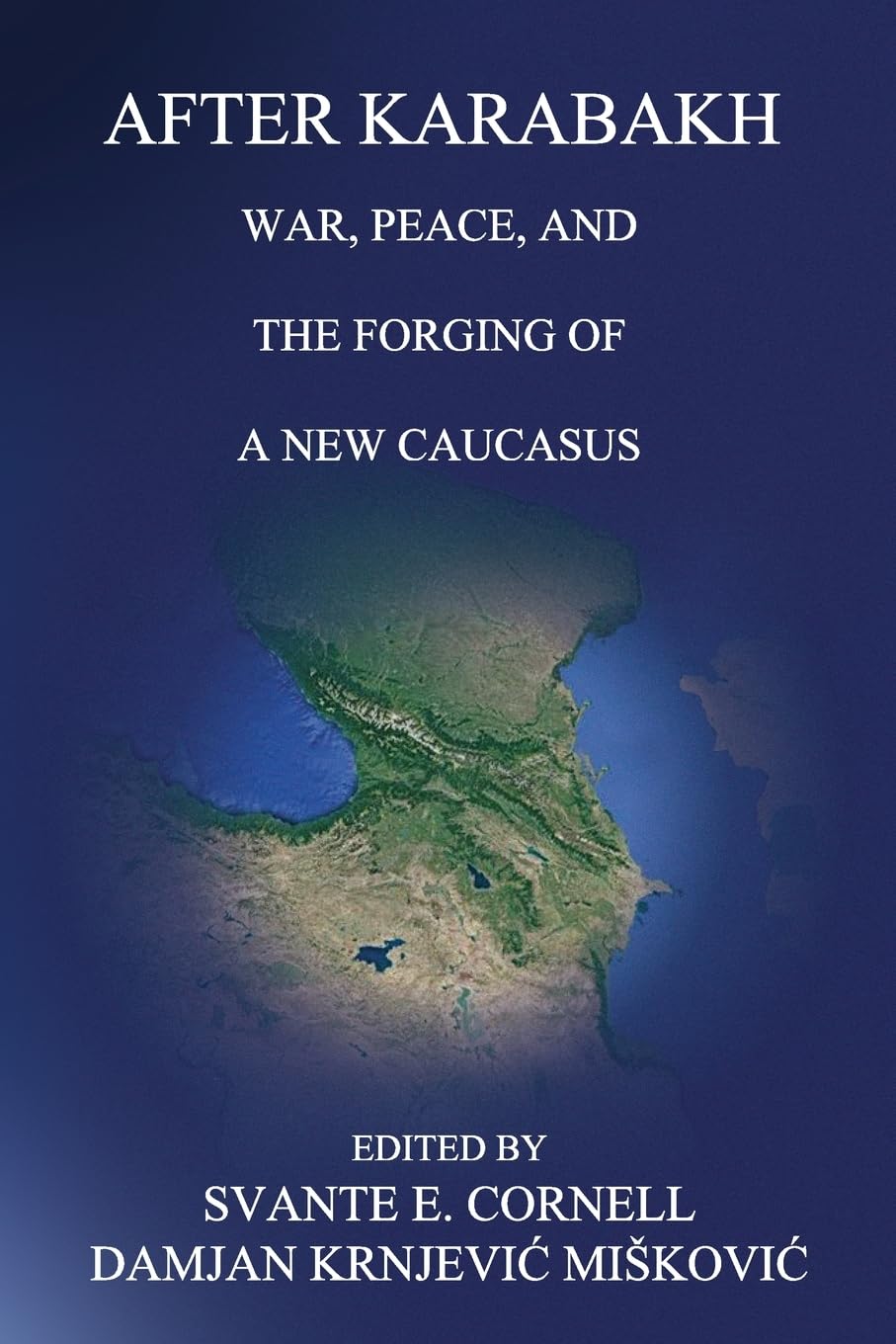
The outcome of the Second Karabakh War is a watershed event in the modern history of Eurasia. It represents the moment of conception of a new South Caucasus, the only part of the world that borders on Russia, Turkey, and Iran. Unsurprisingly, external powers like the U.S., China, the EU, India, and the GCC states are all taking greater interest in its future.
Written for scholars and designed for classroom use, AFTER KARABAKH: War, Peace, and the Forging of a New Caucasus is the go- to book for anyone trying to make sense of the geopolitics of this often misunderstood conflict. As the editors argue in their Introduction, the end of the conflict over Karabakh “will serve as a catalyst for the instauration of a much anticipated peace dividend centered on optimizing the region’s strategic connectivity potential.”
As Michael Doran writes in the Foreword, AFTER KARABAKH “performs a great service to students of international politics. We now have in one volume a set of comprehensive analyses of the main dimensions of the Second Karabakh War. By producing sharp, judicious, and readable accounts, the authors, who are all internationally recognized experts in their fields, have ensured that this volume will become the standard account of the conflict.”
Editors
Svante E. Cornell is Research Director of the American Foreign Policy Council’s Central Asia-Caucasus Institute and a co-founder of the Institute for Security and Development Policy (ISDP)
Damjan Krnjević Mišković is Professor of Practice at ADA University, where he serves concurrently as Director for Policy Research, Analysis, and Publications at the Institute for Development and Diplomacy and Co-Editor of Baku Dialogues.
Table of Contents
Introduction: The Second Karabakh War and a New Caucasus: The Regional Peace Dividend Playing Out at the Card Table; Damjan Krnjević Mišković and Svante E. Cornell
The Geopolitics of the Caucasus and the Road to War; Svante E. Cornell
Perfect Timing and Statecraft: On the Onset of the Second Karabakh War; Damjan Krnjević Mišković
The Foreign and Security Policies of Armenia and Azerbaijan, 1994-2020; Robert M. Cutler
The Evolving Role of the West in the Armenia-Azerbaijan Conflict; Svante E. Cornell
Sitting on Two Chairs: Russia's Pragmatic, Transactional Approach to the Karabakh Question; Nikolas K. Gvosdev
Gradually, then Suddenly: The Evolution of Tiirkiye's Role in the Armenia-Azerbaijan Conflict; Michael A. Reynolds
Iran's Role in the Armenia-Azerbaijan Conflict; Brenda Shaffer
Armenia's Pashinyan Conundrum: Implications of the Second Karabakh War; Onnik James Krikorian
No More War, Not Yet Peace: On the Second Karabakh War and Its Aftermath; Fariz Ismailzade
Military Lessons from the Second Karabakh War; Niklas Nilsson
The Geopolitical Causes and Consequences of the Second Karabakh War: Armenian Tragedy, Azerbaijani Vindication, and Prospects for Peace; Damjan Krnjević Mišković
Has the West "Lost" Azerbaijan?
By Robert M. Cutler
Azerbaijani President Ilham Aliyev’s April 2025 state visit to China, culminating in the signing of a Comprehensive Strategic Partnership, marks a significant elevation in bilateral relations. The agreement is more than a symbolic gesture: it reflects a strategic convergence across infrastructure, energy, and digital development. It also signals a re-balancing of power in the South Caucasus in response to Western inertia. As China consolidates its position, the question is no longer whether the West leads but whether it has already surrendered the initiative.
BACKGROUND: The Second Karabakh War of 2020 abruptly exposed the obsolescence of entrenched diplomatic frameworks in the South Caucasus, most notably the OSCE Minsk Group. The November 2020 Trilateral Statement that ended the fighting, brokered under Russia’s aegis, signified an incipient restructuring of regional dynamics. Russia positioned itself as the nominal guarantor of stability, installing a contingent of so-called peacekeepers on Azerbaijani territory. Yet this maneuver, driven by residual influence and opportunistic calculus, underscored Moscow’s determination to preserve a semblance of relevance amid shifting fault lines.
While Russia acted following long-established and well-defined interests, the U.S. and the EU hesitated. The initiatives introduced by Western actors, preoccupied with internal crises and other entanglements, lacked coherence, confidence, and strategic vision. The mediation efforts were fragmented and the summits were ad hoc. As a result, the promising diplomatic overtures failed to generate substantive traction. The reactive nature of Western engagement post-2020 contrasts starkly with the proactive moves of regional and other stakeholders having more immediate stakes in the evolving South Caucasus order.
Turkey’s deepening military partnership with Azerbaijan, formalized through the Shusha Declaration of 2021, epitomized pragmatic alignment. Kazakhstan, seizing the moment, accelerated its integration into the emergent Middle Corridor, bolstering East-West logistics networks through the Caspian basin. Concurrently, Gulf states capitalized on Azerbaijan’s post-war stabilization by channeling substantial investments into renewable energy infrastructure, particularly solar and wind projects in the liberated territories. These tangible gestures did not just reflect geoeconomic calculations but represented a recognition of the region’s latent economic potential.
In this context, China modified its traditionally cautious posture in the South Caucasus. Historically deferential to Russia’s informal sphere of influence, Beijing began to reassess the region’s strategic significance following the full-scale Russian invasion of Ukraine in February 2022. The resulting destabilization of Eurasian corridors, compounded by Western sanctions and the geopolitical weaponization of supply chains, propelled the South Caucasus from peripheral concern to a central axis in China’s connectivity strategy. This shift was not reflexive or opportunistic. Rather, it reflected China’s measured strategic assessment of the structural transformations in the architecture of Eurasian trade.
By 2022, the foundations for a deepening Sino-Azerbaijani partnership had been firmly established. The signing of a joint declaration on strategic partnership at the Shanghai Cooperation Organization summit in July 2024 signaled a decisive commitment to broaden bilateral economic ties. The two countries’ trade in 2024 was over 20 percent above its 2023 level, reaching nearly US$ 3.74 billion. Chinese enterprises expanded into sectors previously peripheral to their Eurasian ambitions: telecommunications, green energy, and transport logistics. President Ilham Aliyev’s state visit to Beijing in April 2025 did not initiate this trend but rather consolidated it. The Comprehensive Strategic Partnership (CSP) agreement was the logical culmination of sustained and deliberate moves that anchored Azerbaijan’s strategic realignment toward the East.
IMPLICATIONS: The realignment is not mere economic opportunism. Rather, it signals a deeper geopolitical evolution driven by the inadequacy of Western engagement and the region’s preparedness to respond to actors willing to match rhetoric with decisive action. The failure of Western policy is not just about inattentiveness, but also about an inability to grasp the interplay between regional agency, emerging connectivity frameworks, and the geopolitical vacuum created by Russia’s shifting posture. In this unfolding dynamic, Azerbaijan has moved beyond waiting for Western recognition or support. It has instead begun to assert its own role within a rapidly realigning Eurasian order.
For China, Azerbaijan serves as a gateway not only to Europe through the Middle Corridor but also toward the Middle East, reinforcing China’s broader trade architecture and strategic depth in the region. The CSP is not a symbolic gesture. Its scope is broad and consequential, encompassing coordinated industrial development, infrastructure harmonization, technology transfer, and streamlined customs protocols. These measures are underpinned by capital investments and long-term industrial partnerships.
For Azerbaijan, the CSP consolidates a deliberate move to attenuate traditional dependencies on Western and Russian interlocutors. It embodies Azerbaijan’s long-articulated aspirations for economic diversification, substantiated now by tangible capital flows and operational partnerships. The CSP’s provisions span petrochemicals, metallurgy, mechanical engineering, and renewables. Agreements on aerospace and intellectual property signal a strategic depth, eschewing transactional engagement in favor of embedded, systemic collaboration.
The transport dimension alone is reshaping regional dynamics. The Middle Corridor, stretching from China through Kazakhstan, the Caspian basin, and into the South Caucasus and Europe, has demonstrated rapid growth. While still smaller in scale than northern routes traversing Russia, its year-on-year expansion has been notable. A trilateral joint venture among Kazakhstan, Azerbaijan, and Georgia’s rail operators is actively synchronizing digital customs tracking and reducing delivery times to enhance competitiveness.
The Port of Alat, central to Azerbaijan’s maritime logistics, has already undergone substantial upgrades. Cross-border road transport agreements and operational protocols with China, concluded in 2024 and 2025, are streamlining east–west trade flows. China’s formal recognition of Azerbaijan as a "central transit node" underscores the strategic weight of this integration.
The significance of the CSP extends beyond ports and pipelines. Digital infrastructure has emerged as a foundational pillar. Huawei and ZTE, longstanding presences in the region, have solidified their positions through new agreements establishing joint research centers, expanding data infrastructure, and modernizing e-government frameworks. These initiatives are embedding Chinese technological standards into the South Caucasus and positioning Baku as a nascent digital hub.
Energy collaboration has similarly accelerated. China’s Universal Energy is backing the Gobustan solar project, with further discussions ongoing over potential wind energy developments along the Caspian coast. These initiatives are paralleled by an expansion of Chinese soft power, from Confucius Institutes to cultural exchanges and educational programs.
Azerbaijan has not “abandoned” the West. The reality is starker: the West has failed to keep pace with Azerbaijan’s evolving strategic calculus. President Aliyev’s visit to Beijing and the CSP with China are less an embrace of Beijing than a commentary on the chronic insufficiencies of Western engagement. For years, Baku signaled openness to deeper commercial ties, infrastructure investments, and a balanced diplomatic posture. What it often received were half-measures, symbolic gestures, and ideological critiques.
The waning of Western diplomatic leverage in the South Caucasus is not a sudden anomaly. It is the cumulative outcome of incremental miscalculations, fragmentary approaches, and the persistent failure to integrate regional realities into a coherent strategic vision. The 2020 Second Karabakh War marked a decisive inflection point. Azerbaijan’s reintegration of its formerly occupied territories exposed the impotence of frameworks long regarded as the bedrock of resolution efforts. The abrupt reassertion of Azerbaijani territorial sovereignty in 2020, and its completion in 2023, underscored the extent to which Western actors had become disconnected from the region’s evolving dynamics.
Europe’s Global Gateway initiative, though nominally prioritizing the Middle Corridor, remains hesitant and underfunded. The U.S., preoccupied with broader geopolitical contests, has failed to sustain a coherent South Caucasus policy. When attention does surface, it is often filtered through domestic advocacy agendas misaligned with both regional stability and U.S. strategic interests. Thus, under the influence of domestic lobbies, two of the Biden administration’s last acts were to decline to waive Section 907 of the Freedom Support Act, which bans direct assistance to the Azerbaijani government, and to sign a bilateral strategic partnership charter with the Armenian government.
CONCLUSIONS: The South Caucasus has shifted from constituting a peripheral zone to a strategic nexus. Capital and influence from East Asia, Central Asia, and the Middle East are converging upon the region. Turkey, Kazakhstan, and the Gulf states have become active participants in this evolving matrix. Azerbaijan, far from merely serving as a bridge, has assumed the role of architect and builder of new routes. Aliyev’s visit to Beijing is emblematic of this shift. Baku no longer waits for external recognition; it engineers its own relevance.
The West must recognize this not as a defection, but as an adaptation to opportunity over nostalgia. The coming months will be decisive. If the West wishes to remain a meaningful player, it must replace rhetorical overtures with substantive commitments: joint infrastructure ventures, credible support for energy transition, and diplomatic engagement rooted in regional realities rather than encumbered by historical preoccupations.
Azerbaijan’s choice is not between China and the West, but between agency and irrelevance. It has already chosen. The question now is whether the West retains both the capacity—and the will—to respond.
AUTHOR’S BIO: Robert M. Cutler is Director and Senior Fellow, Energy Security Program, NATO Association of Canada. He was for many years a Senior Research Fellow with the Institute of European, Russian and Eurasian Studies, Carleton University.
Former Soviet States Are Distancing Themselves From Their Old Imperial Master
By Erica Marat and Johan Engvall
May 12, 2022
https://foreignpolicy.com/

For many of Russia’s neighbors, the war in Ukraine has accelerated the process of breaking out of Moscow’s orbit and abandoning loyalty to Russian President Vladimir Putin’s regime. While governments from Moldova and Georgia to Kazakhstan are distancing themselves from Putin’s offensive in Ukraine, the war is also prompting a deeper reexamination of the meaning of the past in former Soviet territories. The idea of “brotherly nations” promoted by the Soviets is now overshadowed by the notion that Soviet Russia may have never pursued true equality with its neighbors—not now, nor a century ago when the Soviet empire was established through mass violence.
Thirty years after the collapse of the Soviet Union, Russia is becoming just another neighbor in the eyes of Kazakhs, Georgians, Moldovans, and others.
Several governments have shown greater independence from Moscow than expected. Last month, Kazakhstan declared it wouldn’t hold a military parade to celebrate the Soviet interpretation of its World War II victory. Earlier, Kazakhstan reportedly also refused Russia’s request to supply troops in Ukraine. Both Kazakhstan and Azerbaijan expanded cooperation in rerouting energy supplies to Europe bypassing Russia. As explained by the Kazakh deputy foreign minister, “If there is a new Iron Curtain, we do not want to be behind it.”
The more a country is politically free and allows space for the critical reappraisal of its past, the less its public is likely to support Russia’s regional dominance.
Long-serving Uzbek Foreign Minister Abdulaziz Kamilov spoke out in support of Ukraine’s territorial integrity, including in Donetsk, Luhansk, and Crimea. Perhaps due to political pressure from Russia, he was later removed from his position and appointed to another post. Kyrgyzstan’s foreign minister was sacked as well—likely because of insufficient public support of Russia’s war.
In Moldova, which depends on Russian energy supplies and hosts hundreds of thousands of Ukrainian refugees, President Maia Sandu said her government is following Russia’s actions in Transnistria with “caution and vigilance.” A few days after the Russian invasion in Ukraine, Moldova applied for European Union membership, along with Georgia and Ukraine. Both Moldova and Georgia face Russian occupation of parts of their territories (Transnistria as well as South Ossetia and Abkhazia, respectively), which they don’t recognize as legitimate.
Acts of everyday resistance to Russia’s war in Ukraine in Central Asia and the South Caucasus vary from small businesses posting “Slava Ukraini” (Glory to Ukraine!) next to their products and civil society groups collecting humanitarian aid for Ukraine to members of the public wearing yellow and blue: the colors of the Ukrainian flag. The Russian war symbols Z and V are rare or banned by the state.
Seeing the Soviet regime as a colonialist government both unites nations around a joint history of trauma and builds resistance to Russian attempts to subjugate them. Russian modern imperial ambitions in Ukraine or Georgia look offensive in these countries. The more a country is politically free and allows space for the critical reappraisal of its past, the less its public is likely to support Russia’s regional dominance.
In Kazakhstan, a critical look at its history of mass starvation that killed millions of people have now spilled from academic discussions into the public. In Georgia and Kyrgyzstan, historians and activists now openly blame the Soviet regime for purging national elites. In Ukraine, a sharp turn against alignment with Russia in 2014 came as Moscow annexed Crimea and the occupied Donbas.
Reexamining the Soviet past is taking place despite the fact that most international scholarship still sees the Soviet empire as a modernizing power of a backward people, especially in Central Asia. The seeming equality among nations of the empire and its anti-capitalist stance earned a large following among the anticolonial left in both the West and especially in formerly colonized countries throughout Asia, Africa, and Latin America.
The war in Ukraine is revealing the human costs of the empire’s expansion today even in the face of grassroots resistance. Like Putin’s increasing control of Russia today, the Soviet system was totalitarian, controlling the everyday lives of its people and superimposing Russian culture on all ethnic groups.
Distancing themselves from a romanticized view of their Soviet pasts, these societies are now generating pressure for political change at home—challenging the type of post-Soviet authoritarian leadership model that has been common across the region and has its roots in totalitarian rule. In the past several years, protesters in Armenia, Georgia, Kyrgyzstan, Moldova, and Ukraine demanded reforms to post-Soviet state institutions, such as police and intelligence services that are designed to serve the political elite and not citizens.Anti-regime collective mobilization is a sign of a more politically engaged society that expects participation in decision-making and free elections. Ukraine’s resistance to Russian occupation is the ultimate example of how domestic pro-democracy mobilization rejects authoritarian rule.
In the face of this tide of new expectations, incumbent autocratic leaders are increasingly in peril. For example, in Russia’s closest ally, Belarus, President Aleksandr Lukashenko only managed to survive a prolonged popular uprising in the fall of 2020 once he received support from Putin. Lukashenko was able to suppress the protests, but the collective grievances of Belarus’s society have not been solved. In the early days of the invasion, Belarusian railway workers sabotaged Russia’s supply of equipment to Ukraine. The brave act damaged Russian logistics, preventing the Kremlin from moving troops and materiel forward.
Kazakhstan’s political setup is similar to Russia’s—a president sits at the top of a pyramid of power, doling out posts and assets to allies in return for loyalty and a cut of the spoils. But following Kazakhstan’s nationwide uprising in January, the country faces the test of transforming into a more representative political system. Despite decades of authoritarianism, citizens mobilized in historic protests to demand better economic opportunities and the end of the president’s unlimited political power. Many in Kazakhstan’s uprising were young people of the same age as the independent state itself. They now see themselves as agents of change, willing to risk more than their parents could stomach.
Moscow’s ability to influence national decision-making processes in former Soviet territories appears to be waning. Despite Moscow’s objections, Russian only remains a state language in Belarus, although it retains the status of an official language in Kazakhstan and Kyrgyzstan. Azerbaijan switched from the Cyrillic to the Latin alphabet in the early 1990s while Uzbekistan and Kazakhstan are at different stages of the same transition.
Only four countries have joined the Russian-led Eurasian Economic Union, and the intergovernmental military alliance the Collective Security Treaty Organization (CSTO) has six members, Russia included. Both of these Russian-led organizations are likely to become ever more unpopular among political incumbents and the public. Even after the CSTO intervention in Kazakhstan in January, which helped President Kassym-Jomart Tokayev secure his hold on power, the Kazakh government has shown greater opposition to Moscow’s war than expected.
Russian political influence is also declining because Russian culture is losing its dominant position and has to compete with other worldviews for the hearts and minds of younger generations. These more diverse generations are formed by domestic as well as foreign influences, whether from Turkey, the Persian Gulf, or Europe. Traditional and nationalist-oriented values tend to resonate in more rural areas while liberal ideas and values are usually concentrated in urban centers. Large pro-Ukraine protests were held in Georgia, Kazakhstan, and Moldova. Even in countries like Kyrgyzstan, where the government banned antiwar protests, a few brave activists still filled the streets.
Rather than be pawns that are moved around on the Kremlin’s chessboard, Russia’s neighbors are increasingly turning into active players in the international arena.
Separation from Russia does not necessarily mean these countries will seek a closer alignment with the West. Political incumbents in Central Asia and the South Caucasus may be more inclined to seek closer ties with China and Turkey. Countries that depend on Russia’s political and military support—notably Armenia, Kyrgyzstan, and Tajikistan—may still show careful support of close ties with Moscow. But even there, political leaders shied away from publicly siding with Putin’s rhetoric of “denazification” in Ukraine. The unpredictable consequences of Russia’s war might leave these states no other choice but to diversify their diplomatic relations.
Rather than be pawns that are moved around on the Kremlin’s chessboard, Russia’s neighbors are increasingly turning into active players in the international arena—and have not hesitated to play external powers against one another to extract maximum benefits. They prefer to maintain ties with many regional powers; Russia is becoming just another neighbor, along with the EU, China, Turkey, and Iran.
In that way, Central Asian countries are becoming more like other countries in Asia and Africa—searching for multilateralism rather than solely attaching themselves to one actor: Russia. The ability of these states to resist Moscow’s pressure to support the invasion of Ukraine would not have been possible without their long-standing efforts to preserve their sovereignty and identity themselves by diversifying their diplomatic alliances.
To understand the effectiveness of Russian power in the former Soviet space, it is no longer sufficient just to know the Kremlin’s intent. Former Soviet colonies are on the verge of breaking away from the last remaining legacies of Soviet rule. The war in Ukraine points at the need to consider countries formerly occupied by the Soviet regime as entities with their own complex domestic processes despite Russia’s efforts to direct and dominate them.
Many citizens of former Soviet states in Central Asia and the South Caucasus now see Russia as a belligerent neighbor engaging in genocidal violence rather than as an historic ally. Time is thus not on the side of Putin’s imperialistic and nationalist crusade to reassert Russia’s exclusive control over its neighboring countries—because Moscow’s neighborhood is no longer a collection of its former colonial subjects.
CACI Forum: A Conversation with Ambassador Khazar Ibrahim