Youth and Digital Technology in Central Asia: A Comparative Analysis of Uzbekistan, Kazakhstan, Kyrgyzstan, and Tajikistan

By Farrukh Irnazarov
Central Asia-Caucasus Institute & Silk Road Studies Program
Silk Road Paper
December 2025
Click Here to Download
Executive Summary:
 Central Asian youth between the ages of 15 and 29 are driving the region’s digital transformation, though opportunities are unequal across the region. This comparative study of Kazakhstan, Kyrgyzstan, Tajikistan, and Uzbekistan draws on a 468-respondent youth survey and extensive secondary data to map five dimensions of the online landscape.
Access and Devices. Mobile internet has eclipsed all other channels: Kazakhstan, Kyrgyzstan, and Uzbekistan report 89 to 93 percent general adoption rate, while Tajikistan lags at 57 percent. Registered mobile service lines exceed population numbers in every country—reaching 159 percent in Kyrgyzstan—indicating that smartphones are the primary tool for study, work, and leisure.
Platforms and Culture. Telegram is the region’s primary newswire, while Instagram and YouTube shape identity and TikTok dominates leisure time. √ now trails social media as the main news source for Central Asian youth.
Socio-Economic Payoff. Digital skills open doors to remote work and start-ups — Kazakh ventures drew $71 million in venture capital and Uzbek ventures drew $17 million in 2024 — yet rural youth still face slow service and limited access to devices, widening the divide.
Literacy Gap. Nine in ten youths say accuracy matters, but barely half fact-check routinely, leaving them exposed to propaganda and fake news, despite growing efforts by non-governmental organizations (NGOs) to provide education on the topic.
Structural Limits. Cheap mobile data masks deeper barriers: expensive fixed broadband, patchy rural coverage, and renewed censorship hamper innovation and voice.
Country Snapshots. Kazakhstan leads the region in digital infrastructure, but risks repeat shutdowns; Uzbekistan saw growth after 2016 yet still grapples with red tape; Kyrgyzstan’s once-vibrant online sphere is tightening; and Tajikistan remains the most constrained.
What Works. The priorities are clear: complete last-mile broadband infrastructure, support an open and free internet, embed media-savvy curricula into education, and streamline start-up regulation and funding—especially for young women and rural creators. Achieving these goals will turn today’s mobile-native generation into the region’s next growth engine.
Central Asia in the Energy Transition
 Svante E. Cornell and Brenda Shaffer
December 4, 2024.
Click to Download
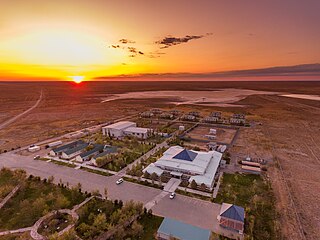
The United States, Europe, the United Nations and more are promoting a top-down energy transition from fossil fuels to renewable energy, which shows no signs of emergence. Under this scenario, Europe and the global market are likely to maintain demand for the energy riches of Central Asia for many decades to come. The gas market of Central Asia itself requires additional gas volumes as well. In order to lower carbon emissions and air pollution and improve public health in Central Asia, the ideal policy in the region is increased access to natural gas that can replace the widespread burning of biomass and lump coal. Current European policies promote expanding electrification and is leading to a new look at nuclear energy. Accordingly, the uranium deposits of Central Asia have become of high commercial and geopolitical interest.
Watch: 4/23 Rumsfeld CAMCA Spring '24 Fellows Presentation: Advancing Digital Interconnectivity in CAMCA Region
A presentation by the Spring 2024 CAMCA Fellows, focusing on the advancement of digital connectivity in Central Asia, Mongolia, the Caucasus, and Afghanistan. In the interconnected landscape of the CAMCA region, digital connectivity serves as a cornerstone for both economic prosperity and social progress. This event is not merely about enhancing digital infrastructure; it's about fostering deeper connections across the region. The Fellows will delve into how overcoming challenges is crucial for unlocking economic potential, ensuring equitable access, and driving regional integrati
Register for the 2024 CAMCA Conference - June 12-13 - Bishkek, Kyrgyzstan
Register for the annual Central Asia - Mongolia - Caucasus - Afghansitan (CAMCA) Regional Forum scheduled for June 12-13 in Bishkek, Kyrgyzstan. The CAMCA Regional Forum is a non-political and non-partisan Forum established to promote region-wide discussions on means of advancing economic growth and development in the 10 countries of the region: Afghanistan, Armenia, Azerbaijan, Georgia, Kazakhstan, Kyrgyzstan, Mongolia, Tajikistan, Turkmenistan and Uzbekistan. It promotes this goal by fostering dialogue and interaction among rising young leaders from all sectors in the 10 countries of the region, as well as with international leaders and stakeholders. The Forum organizers - the CAMCA Network, Central Asia-Caucasus Institute and the Rumsfeld Foundation - believe that expanded communication and collaboration among talented professionals from a range of fields can significantly contribute to economic, political and social development on both a national and regional basis.
The Forum is a premier opportunity to engage with prominent influencers and leaders in the CAMCA region and to gain firsthand insights on the region’s pulse and latest developments. The Forum’s non-political and non-partisan mission facilitates an environment for open conversation aimed toward the prosperity of the region and its people. The Forum was established as one of the first and only platforms to bring together representatives of the 10 CAMCA countries, spanning from the South Caucasus to Mongolia, to discuss emerging opportunities for regional cooperation and integration. Due to the diverse and impressive pool of participants, the Forum essentially serves as a ‘one-stop shop’ for professionals of all sectors who are interested in regional cooperation and partnerships, as well as for outside nations, businesses and organizations that have an interest in engaging with the region.
Click here for more information and to register.
Watch the 12/8 CACI Webinar - Reform Implementation In Central Asia
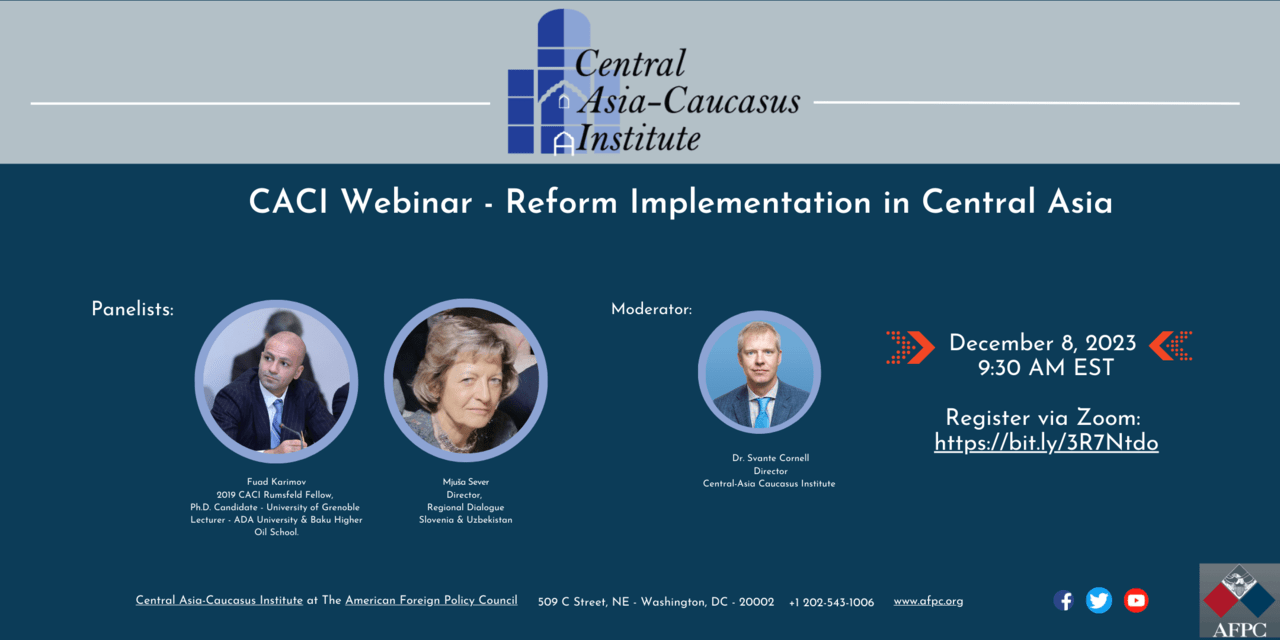
Central Asian governments, particularly Kazakhstan and Uzbekistan, have embarked on a series of reform initiatives in recent years. Announcing far-reaching reforms is one thing, but implementation is another. This CACI webinar delves into the question how the process of implementation of reform agendas is processing.
PANELISTS:
- Mjusa Sever, Director, Regional Dialogue, Slovenia & Uzbekistan
- Fuad Karimov, 2019 CACI Rumsfeld Fellow, Ph.D. Candidate - University of Grenoble and Lecturer - ADA University & Baku Higher Oil School
MODERATER:
- Dr. Svante Cornell, Director, Central Asia-Caucasus Institute
Watch the video below or on YouTube